When companies talk about digital twins, the conversation often starts with technology. But the real driver is much simpler: reducing uncertainty and minimise risks in your project lifecycle
In production and automation environments, small errors can have a big impact. Component and resource shortage, access to equipment, unexpected downtime, material waste, or safety risks often stem from decisions made too late when systems are already built and running. This creates delays and, in some instances, lower quality in the end product.
Digital twins mitigate this by changing that timeline.
Moving decisions earlier
A key advantage of a digital twin is that it allows companies to test and validate much earlier in the process, instead of waiting until machines are built, systems are installed or production is running
Digital twins enable you to simulate and emulate behaviour in advance. From the early design considerations automation engineers can start testing logic, and operators can be included. And that shift matters.
The cost of fixing errors increases significantly the later they are discovered. Identifying issues in a virtual model is both cheaper and faster than correcting them on a physical production line.
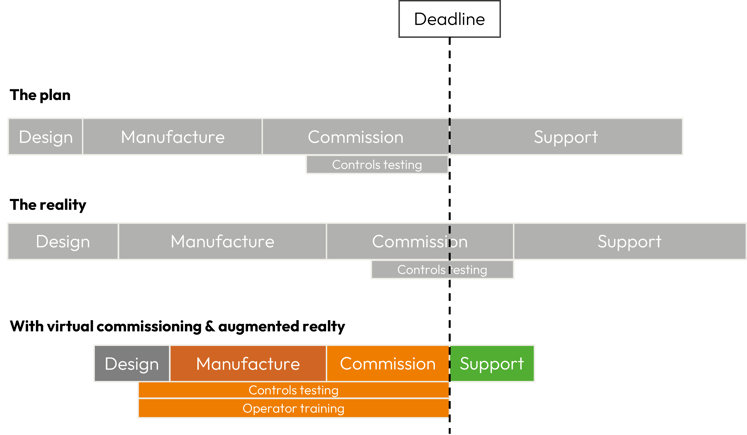
Fig: Example of development process before and after introducing digital twin technology
Reducing physical constraints
Traditionally, development and testing depend heavily on access to physical equipment. This creates bottlenecks in terms of limited machine availability, production interruptions, and travel requirements for specialists.
However, with a digital twin, much of this work can be decoupled from the physical environment. Teams can test logic and sequences without stopping production, develop and validate solutions remotely, and run multiple development tracks in parallel. This creates a more scalable and flexible way of working, especially in global or distributed setups.
Improving quality through iteration
A digital twin doesn’t eliminate uncertainty entirely, it simply enables faster iteration.
Instead of testing once and hoping for the best, teams can:
- access the equipment when they have time
- run multiple scenarios without interrupting other members
- test edge cases
- fine-tune system behaviour
This iterative approach improves system quality before deployment and reduces the number of issues that need to be resolved later.
Enabling safer testing
In many industrial environments, testing certain scenarios in the real world is either difficult, risky, or simply not possible.
On the other hand, with a digital twin companies can simulate faults and failure scenarios, validate safety functions, and test extreme conditions. All without exposing people, equipment or production to risk.
More than cost savings
While cost reduction is often part of the case, the value of digital twins goes beyond simple ROI. Instead, it’s about:
- speed – faster development cycles
- quality – fewer errors in production
- flexibility – easier adjustments and updates
- resilience – better handling of unexpected situations
In other words, digital twins don’t just make processes cheaper, they make them more robust.
In conclusion
Digital twins can create value by shifting work methods, reducing reliance on physical systems, and enabling better decisions before they become expensive and reduce stress during delivery.
Want to talk about your needs and how a digital twin can support your business? Reach out to Lotte Høeg Jul Jensen, Head of Digital Twin & AI at ProjectBinder: